bare feet in the sand

the beauty of nature in a consumer economy


Leave a comment

Climate Myths by John J. Berger

I recently read Climate Myths by John J. Berger.  I was hoping to learn more about the science of climate change and what, if any, controversies still exist in the scientific community.  Perhaps my expectations were faulty, but I was sorely disappointed by the book.  The first (and very significant) portion of the book is dedicated to the various organizations that have gone out of their way to dispute climate change and how serious it is.  He mentions organizations that don’t exist anymore, which may be interested to a researcher but seem to have no relevance for me.  What was helpful was his discussion of certain more prominent climate deniers and why their credentials make them less credible than climate scientists who all agree on global warming and its impacts.  However, I didn’t like how far he goes in disparaging some of the organizations, even comparing them to Joseph McCarthy and the anti-communism in the 1950s.

I was disheartened to learn about how the media has helped these organizations and climate deniers by giving them as much air time as the thousands of scientists who agree on the gravity of global warming.  One of Berger’s examples was The Wall Street Journal, and here is an article I found: No Need to Panic About Global Warming.  If you look at the sixteen scientists who signed the articles very few, if any, are on the cutting edge of climate science.

Another reason for my reading the book was to feel more prepared to refute in conversation those who might be on the fence about global warming.  The second (and much shorter) part of the book is helpful for that.  He goes through the various ‘myths’ and why they are flawed.  I was very glad to find out about the reports from the Intergovernmental Panel on Cimate Change (IPCC) that operates under the U.N.  American politics being what they are, this seems like a good place to point people.

I hope to find books that I feel more ready to recommend.  This one is helpful only if you’re specifically interested in the organizations (past and present) who have made enough of American doubt climate change so that politicians are unable to make any progress.

Leave a comment

The Last Reef IMAX movie

Coral reefs are some of the most beautiful places on Earth and according to the recent IMAX movie The Last Reef they may be gone within our lifetime.  It starts by talking about the amazing variety of species that live in coral reefs, from coral to fish to sea slugs.  Sea slugs, or nudibranchia, look a lot like land slugs, but come in a tremendous variety of beautiful coloring.  The Last Reef  also talked about how many of these animals live in symbiosis and depend on each other for survival.  An example of this is the relationship between coral anemones and clown fish.  Anemones are poisonous to most fish and so the clown fish live within them to stay safe.  The clown fish defend the anemone and keep it clean.  The biodiversity and relationships between all the different living organisms is phenomenal.

The second half of the film talks more about what is threatening coral reefs.  One of their major points is about the amount of CO2 in the ocean and how as it increases so does the acidity of the oceans.  People with fishtanks have to make sure the pH remains within certain levels and the ocean is no different.  There is also the rise in ocean water temperature which often results in coral bleaching.  Coral bleaching is caused when the symbiotic relationship between coral and algae is disrupted, often by water temperatures above what the coral is used to.

According to the movie, coral reefs are disappearing five times faster than rainforests.  The effects are being felt on shores that have been protected from the ocean by reefs, and by the entire ocean population.  I would like to say that the end of the movie felt alarmist, but unfortunately they are right and I hope that more will be done to save coral reefs.

I watched the movie at the Museum of Science, Boston.


2 Comments

Walden Pond

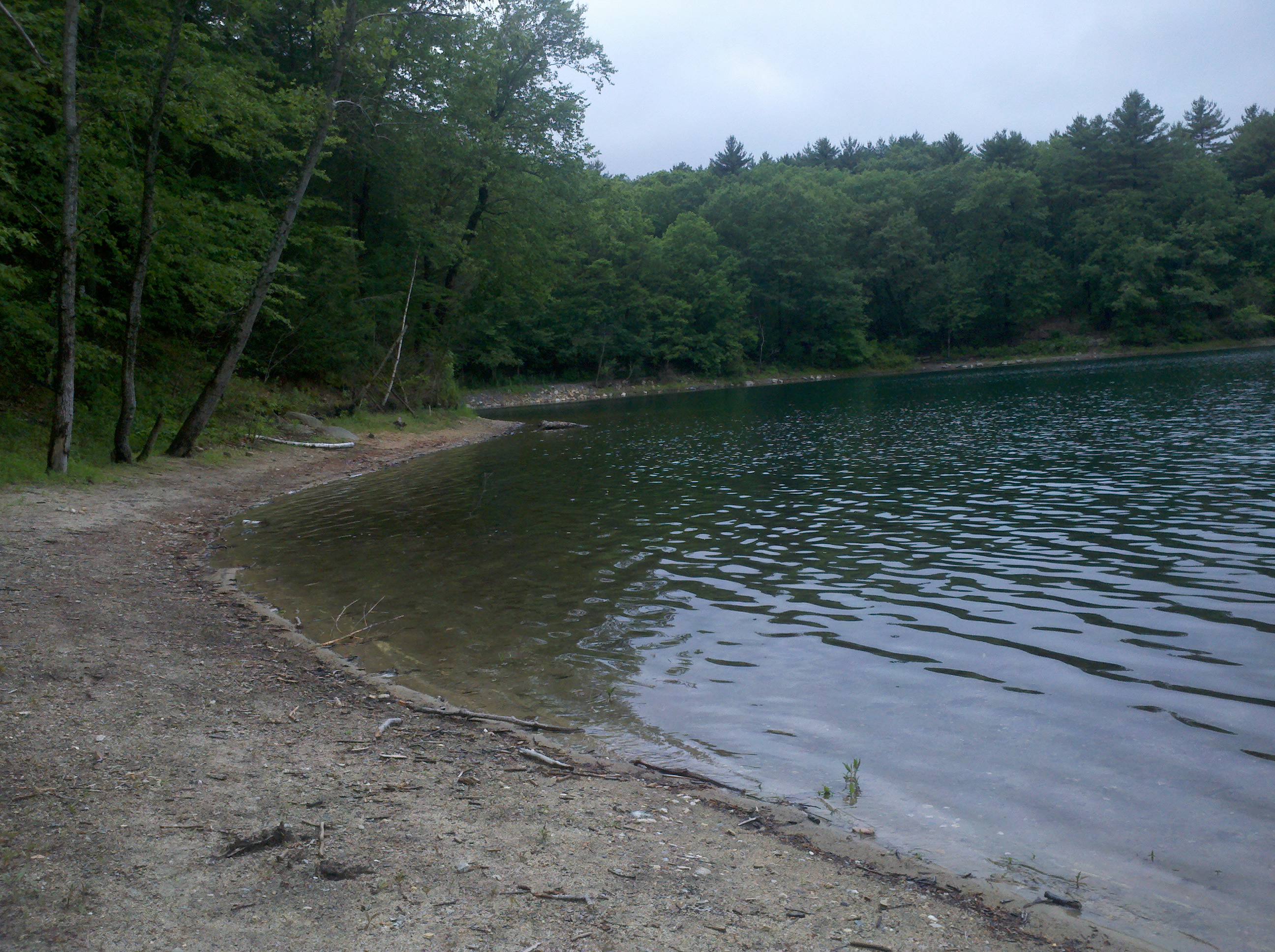
I went for a walk around Walden Pond with a friend today.  I’m always amazed by how isolated it is.  It is so close to Rte. 2 and all of the construction that is currently going on along it.  But the only noise not by nature that I heard was from the train that runs by the pond.  Seeing the site of Thoreau’s house always makes me think about the past.  Thoreau’s Walden is one of my favorite books (actually along with most of Thoreau’s writings).  Compared to when Thoreau lived there, it is not isolated at all.  In fact there’s a building by the biggest beach, signs and fences everywhere.  Along the walk, we’re constantly being told to stay on the path.  Thoreau was able to wander as he pleased and explore every inch of the much larger forest that surrounded the pond.  What he did was extraordinary even for his times, but I still feel like we can learn a lot from his ideas.  Simplify.  Live in harmony with nature.  Buy and take only what you will use.  I’m not saying that’s how I live or that we should all grow our own food.  But I do think we should be more aware of where our food comes from and consider all of things that live in our basement and never see the light of day.  walden pond


2 Comments

the beginning

I fell in love with the natural world in the summers at the beach.  Every year my family spent at least a week on Cape Cod while I was growing up.  And I have gone back for at least a few days every single year of my life, mostly still with my family.  I’m not sure I’ll ever think anything is as beautiful as the beaches of Wellfleet.  The water may be cold but to me it’s not the ocean unless it numbs your feet after ten minutes.  I’ve seen those beaches in bright, hot sun and in wind and rain.  But they are always beautiful.

As I grew older and became more aware of humans’ devastating effects, I worry that all that amazing beauty is fading.  I recently read in a book, Crazy Horse and Custer, about how when the English settlers first arrived in Ohio it was covered in beautiful forests.  They spent years cutting down and burning all of those trees in the name of progress.  I’d like to think that we (as in the human race) have learned better, but I fear that’s not the case.

I believe that when it comes to confronting a societal problem (and I do think that our disregard for the Earth has become rooted in our society) the first step is awareness.  And maybe with awareness and knowledge that will go with it, enough of us will take the correct steps toward fixing this problem.  I have decided I need to do my part.  Image