
I just came back from two weeks in Europe. It was the first time I was there while keenly aware of renewable energy and our environmental impact. I spent a majority of the time in Germany and was very impressed with what I saw. I drove through most of Bavaria (or Bayern). Almost every town, no matter how small, had at least one house or barn with solar panels on its roof. Driving along the autobahn I saw several solar panel farms. I did not go out of my way and yet I saw solar energy everywhere. If a roof wasn’t at a good angle, the solar panels were tilted on top of the roof. You can see examples in the pictures below. Even as I was working on creating this post, I came across an article on Treehugger (one of my favorite sites) about Germany’s solar power. Their pictures are of better quality and look like what I saw while I was there. I was very glad to know that what I saw was being used. 
Tag Archives: environment
Energy Efficient Homes
One of the things I want to do with my blog is help the average person (if there is such a thing) know how to be more eco-friendly and energy efficient. Not everyone wants to go out of their way, but there are still small things we can do. There are also bigger things we can do, especially if we own a home. I do not – I’m a renter with no control over the fact that my windows don’t always shut properly. My parents do own a home. They have recently decided to make some changes and I think they are worth sharing.
The first thing they did was put solar panels on their roof. It was something they had thought about because of the established technology that gives clean, efficient energy. However, they had found out that it cost $40,000 to put them on. A friend of theirs got some help and put them on for half that, but it was still too much. Then Vivint Solar came to their door with a proposal which they accepted. Two of their friends who lived in the area (including an engineer who looked at the schematics) had already had the solar panel installed. The basis for the deal is that Vivint Solar is ‘renting the roof’, and so there is no upfront cost. My parents get a percentage of the electricity generate by the solar panels and the rest Vivint Solar sells to NStar (or whatever energy company who is the energy provider). Their bill to Vivint Solar fluctuates based on the amount generated and the amount used but has been about $60-80. Their electric bill used to be about $200/month. This summer they have been paying nothing or a few dollars to NStar. They expect to pay more in the winter, but it should still be about half of what they were paying before. It seems like a good deal economically as well as environmentally.
Their next step is changing their heating and cooling system so that they are much less dependent on oil. This proposal came from Next Step Living. My parents knew nothing about this, but are interested in helping the environment and this proposal also came with no upfront costs. Two of their friends also have this technology in their homes. It is a Total Climate Control system made by Fujitsu that works with condensers outside of the house. Each room gets a heating and cooling unit or a vent in the ceiling from a unit in the attic, each of which has an individual thermostat. The oil system stays in place because the system doesn’t work when the temperature gets too cold (as in -5 degrees Fahrenheit). Before it is installed an energy audit is required. My parents had Next Step Living do it. They were given a list of suggestions and free energy efficient lightbulbs. They are only paying $500 of the cost of implementing the suggestions. In terms of the money, Next Step Living works with Commerce Bank, NStar and MassSave, and my parents are securing a zero interest loan of about $23,000. It will take them about 7 years to repay after which they will own the system and not have to pay. It means that instead of paying $340/month for oil, they will pay whatever small amount they use when it gets really cold in the winter and $274/month to repay the loan for those 7 years.
High Tide on Main Street by John Englander
I read this book based on a recommendation of another blogger and I am so glad I did. One of the best things about it is the amount of charts, graphs and pictures that are used. It is particularly helpful when he shows graphs of long periods of times and then blows up the more recent past to show the effects that recent greenhouse gas emissions have had. I realize that I was already a believer, but it does seem to prove that humans are changing the atmosphere and sea level.
This book has a lot of science in it, but it was still incredibly readable. I am not someone who enjoys reading science textbooks, or even scientific studies. John Englander has made the science understandable and easy to digest. There were plenty of things I wasn’t aware of – like the cycle of ice ages and how we are actually due to start the cooling phase heading toward another ice age. The sea level is at the high point with less water trapped in ice sheets. It looks like this started to happen in the past centuries but something (humans) changed the course of history. (Not to sound too dramatic.)
Did you know? Sharps Island off Maryland sunk into the Chesapeake Bay in 1962? Apparently due to sea level rise, erosion and sinking land. Holland Island, also in the Chesapeake, disappeared in 2010. Or how about this? “At our current rate of carbon emissions, we will increase carbon dioxide levels… roughly 20,000 times faster than at any time in the last 540 million years. Temperatures… are now rising about 55 times faster than they did even during the most recent cycle of glacial melting.”
Englander also talks about the impacts of sea level rise. Here is a website that models sea level rise on the coastline of the U.S.: Climate Central. The NOAA also has one. He goes through various cities and talks about what they would face and how much of their population would be effected. It is worth noting that along with changes in shoreline, the water table will rise with sea level and so many inland areas will also be affected.
Here are a couple more links from the book that I thought were interesting:
Paper or Plastic?
I think that everyone knows that to be environmentally conscious we should use reusable bags when we go to the grocery store. I would like to say that this is what I do. The truth is that most of the time I stop by the grocery store on the way home from somewhere else and didn’t put a reusable bag in my car. That means that I am confronted with the question at the checkout: paper or plastic? Today I chose paper. And then I decided to do research. It turns out that more energy goes into the making of and the recycling of paper bags, so plastic is the more energy efficient choice. This was not the answer I was expecting to find. There are negatives to plastic bags, including the well-known fact that the plastic almost never breaks down and can injure wildlife if it becomes litter.
Here are some sources:
A very concise view: HowStuffWorks
A long explanation from one of my favorite blogs: Treehugger
The New York Times weighs in: New Proposals Like Neither
Overheated by Andrew Guzman
The subtitle for this book is The Human Cost of Climate Change. It paints a scary picture of what the world will look like in fifty years and a hundred years. It also makes a compelling argument for why we can’t afford to ignore what is happening. The book assumes that there will be a 2 degree Celsius rise in temperature by 2100. This is on the low end of the temperature rise that can be expected. It’s smart in that it allows the author to avoid being considered too alarmist and it turns out even a 2 degree rise would be horrific. I think everyone should read this book. Rather than write a true review, I would like to highlight some of the author’s major points.
I knew that the Industrial Revolution was the beginning of humanity’s love affair with releasing greenhouse gases (GHGs, the most important of which is carbon dioxide) into the atmosphere. What I didn’t realize was that the Earth didn’t start warming immediately. It wasn’t until the 197os and 80s that it started and it started slowly. This delay means that even if we stop releasing GHGs entirely right now the Earth would still warm for a while.
One of the major human impacts of climate change will be the displacement of people. People will be forced out of their homes for a variety of reasons; rising oceans will force people away from the coast, higher temperatures will cause droughts and widening deserts, glaciers melting will cause floods in one season and droughts in another. Glaciers store water and release it into rivers as they melt. Melting too fast or disappearing and melting not at all creates floods, droughts and then a lack of water. Hurricanes and other major weather events will get worse because warm ocean water fuels hurricanes. These displaced people will live in refugee camps and overcrowded cities that will have poor sanitary conditions and people packed together breed disease.
The politics involved in global warming are complicated to say the least. But certain things are relatively clear. Rivers don’t pay attention to political boundaries and the need for water will cause conflict. For example, Turkey puts a dam on the Euphrates River and Syria and Iraq have a lot less water to work with. Tens of thousands and maybe millions of people moving to other countries when their countries are no longer habitable will also cause political tension.
What you don’t want to know: There are island nations, including the Maldives and Tuvalu, who will disappear under the sea even if we start cutting GHG emissions right now. “The level of GHGs today is higher than at any point in at least 650,000 years and is currently rising more than fifty times as fast as what would be caused by natural fluctuations.” “The best information we have from still-earlier periods suggests that you would have to go back at least 15 million years to find another time with concentration levels [of CO2] as high as today’s. During that period, temperatures were much warmer than they are today, sea levels were 20 to 35 meters higher, and no permanent ice cap existed in the Arctic.” “Every year, a part of Nigeria about the size of Rhode Island turns to desert. Across the continent, the Sahara is spreading southward at a rate of more than three miles a year.” “Between the mid-1970s and the year 2000, for example, climate change caused the annual loss of more than 150,000 lives….”
I have been reading in a new book, which I will review soon, about sea levels rising as a consequence of global warming. A friend of mine found this article. Don’t forget to click on the left to see the pictures change as sea levels rise. It may seem like the 25 feet rise won’t happen for so long that it isn’t even worth thinking about. Think about how many people will be displaced by 5 feet in Back Bay, and remember that Boston has resources and wealth to deal with it. There are many countries in the South Pacific that will have much more significant flooding and will not have a wealthy nation helping the people who are displaced.
Supreme Court and the Environment
Many people are celebrating the two Supreme Court rulings on gay marriage today. It’s important not to overlook a ruling that was made that can do significant damage to government protection of the environment.
Climate Myths by John J. Berger
I recently read Climate Myths by John J. Berger. I was hoping to learn more about the science of climate change and what, if any, controversies still exist in the scientific community. Perhaps my expectations were faulty, but I was sorely disappointed by the book. The first (and very significant) portion of the book is dedicated to the various organizations that have gone out of their way to dispute climate change and how serious it is. He mentions organizations that don’t exist anymore, which may be interested to a researcher but seem to have no relevance for me. What was helpful was his discussion of certain more prominent climate deniers and why their credentials make them less credible than climate scientists who all agree on global warming and its impacts. However, I didn’t like how far he goes in disparaging some of the organizations, even comparing them to Joseph McCarthy and the anti-communism in the 1950s.
I was disheartened to learn about how the media has helped these organizations and climate deniers by giving them as much air time as the thousands of scientists who agree on the gravity of global warming. One of Berger’s examples was The Wall Street Journal, and here is an article I found: No Need to Panic About Global Warming. If you look at the sixteen scientists who signed the articles very few, if any, are on the cutting edge of climate science.
Another reason for my reading the book was to feel more prepared to refute in conversation those who might be on the fence about global warming. The second (and much shorter) part of the book is helpful for that. He goes through the various ‘myths’ and why they are flawed. I was very glad to find out about the reports from the Intergovernmental Panel on Cimate Change (IPCC) that operates under the U.N. American politics being what they are, this seems like a good place to point people.
I hope to find books that I feel more ready to recommend. This one is helpful only if you’re specifically interested in the organizations (past and present) who have made enough of American doubt climate change so that politicians are unable to make any progress.
The Last Reef IMAX movie
Coral reefs are some of the most beautiful places on Earth and according to the recent IMAX movie The Last Reef they may be gone within our lifetime. It starts by talking about the amazing variety of species that live in coral reefs, from coral to fish to sea slugs. Sea slugs, or nudibranchia, look a lot like land slugs, but come in a tremendous variety of beautiful coloring. The Last Reef also talked about how many of these animals live in symbiosis and depend on each other for survival. An example of this is the relationship between coral anemones and clown fish. Anemones are poisonous to most fish and so the clown fish live within them to stay safe. The clown fish defend the anemone and keep it clean. The biodiversity and relationships between all the different living organisms is phenomenal.
The second half of the film talks more about what is threatening coral reefs. One of their major points is about the amount of CO2 in the ocean and how as it increases so does the acidity of the oceans. People with fishtanks have to make sure the pH remains within certain levels and the ocean is no different. There is also the rise in ocean water temperature which often results in coral bleaching. Coral bleaching is caused when the symbiotic relationship between coral and algae is disrupted, often by water temperatures above what the coral is used to.
According to the movie, coral reefs are disappearing five times faster than rainforests. The effects are being felt on shores that have been protected from the ocean by reefs, and by the entire ocean population. I would like to say that the end of the movie felt alarmist, but unfortunately they are right and I hope that more will be done to save coral reefs.
I watched the movie at the Museum of Science, Boston.
Walden Pond
I went for a walk around Walden Pond with a friend today. I’m always amazed by how isolated it is. It is so close to Rte. 2 and all of the construction that is currently going on along it. But the only noise not by nature that I heard was from the train that runs by the pond. Seeing the site of Thoreau’s house always makes me think about the past. Thoreau’s Walden is one of my favorite books (actually along with most of Thoreau’s writings). Compared to when Thoreau lived there, it is not isolated at all. In fact there’s a building by the biggest beach, signs and fences everywhere. Along the walk, we’re constantly being told to stay on the path. Thoreau was able to wander as he pleased and explore every inch of the much larger forest that surrounded the pond. What he did was extraordinary even for his times, but I still feel like we can learn a lot from his ideas. Simplify. Live in harmony with nature. Buy and take only what you will use. I’m not saying that’s how I live or that we should all grow our own food. But I do think we should be more aware of where our food comes from and consider all of things that live in our basement and never see the light of day. 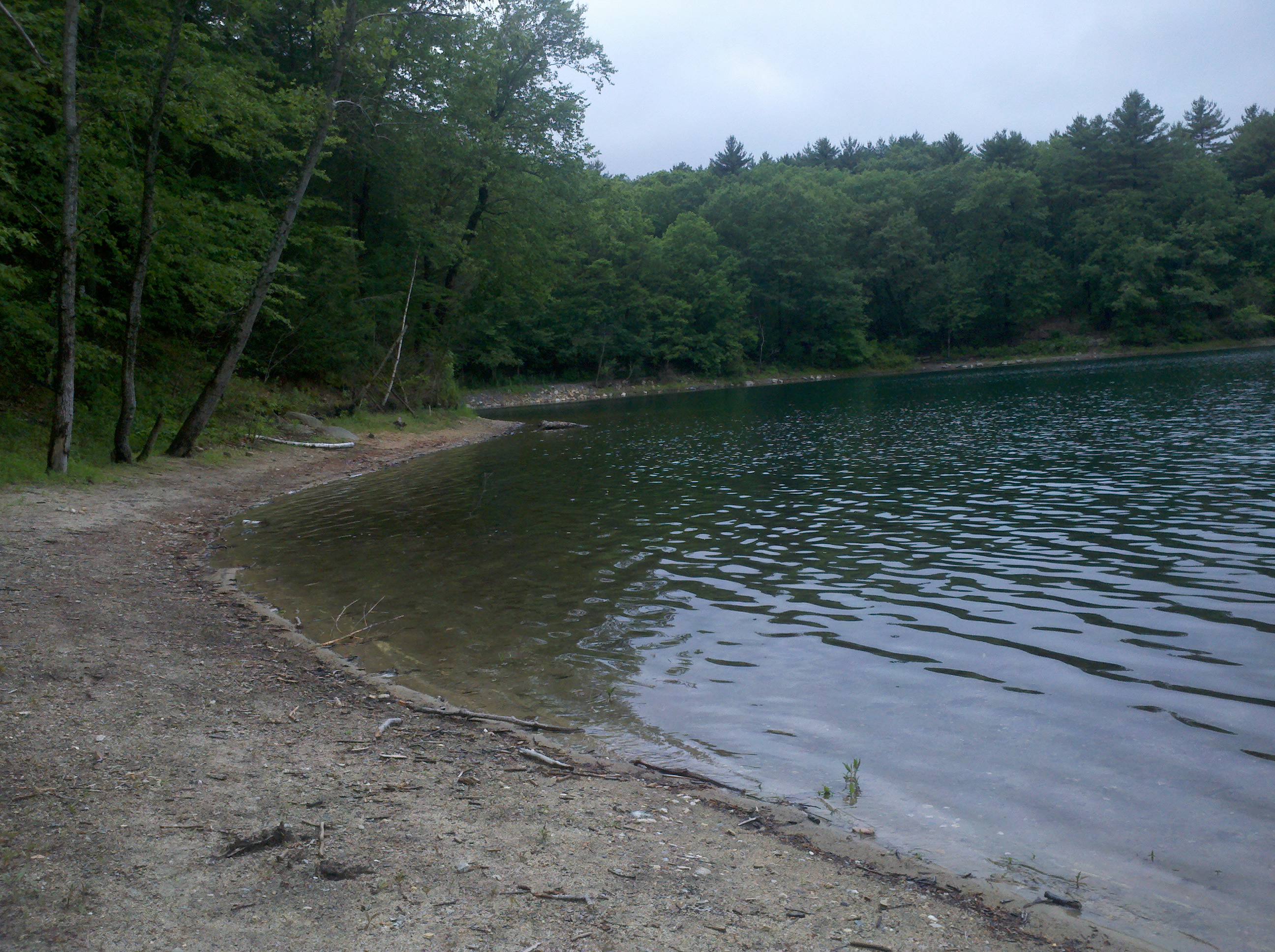
 bare feet in the sand